What is a piezo actuator?
24.05.23
Why is closed loop control important?
Piezo actuators rely, not unsurprisingly, on the piezoelectric effect. This was originally discovered by two French scientists – brothers Jacques and Pierre Curie – way back in 1880. They found that if you applied a mechanical force to a quartz crystal then it generated an electric current. Just a year later, following theoretical work by fellow scientist Gabriel Lippman, the brothers were also able to demonstrate that there was an inverse piezoelectric effect, where an electrical field applied to a crystal caused it physically to deform. This phenomenon relies on the unique crystal structure of materials such as quartz and ceramics, which have non-centrosymmetric lattice structures (i.e. where their atomic structure does not contain symmetric inversion centers, with an identical structure either side of each center point). In practice, this means that the arrangement of positively and negatively charged atoms are unevenly distributed throughout the crystal, but in such a way that the material normally has an electrically neutral balance. However, when mechanical stress or strain is applied to the crystal, its structure deforms. This effectively pushes the atoms closer together or forces them apart, changing the electrical balance and releasing a net electrical charge.
The inverse piezoelectric effect
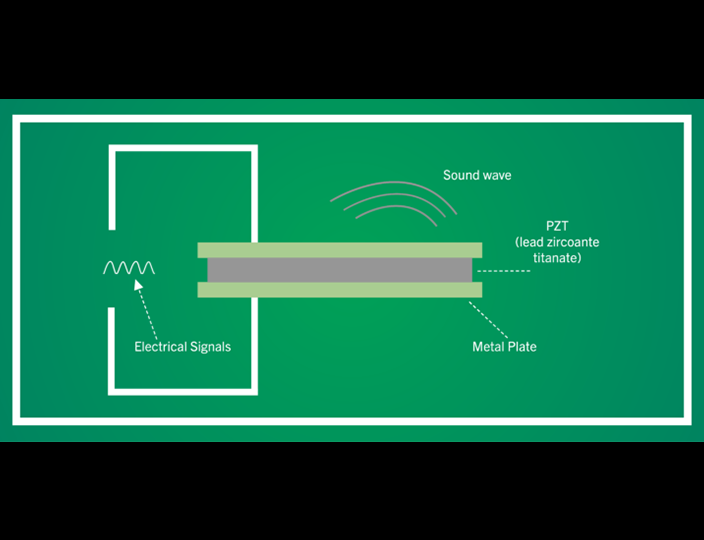
Conversely, when an electrical charge is applied across a crystal it essentially creates an ‘electrical pressure’. This forces the atoms to move to rebalance their structure, thereby producing a small change in the dimensions of the crystal. It is this inverse piezoelectric effect that we exploit in our nano actuation systems. These use a specially developed stack of PZT ceramic elements, interleaved with conducting electrodes, as the driving mechanism for each actuator. The secret to utilizing the piezoelectric effect for nanopositioning systems is being able precisely to predict and control the degree of movement for each actuator. Unfortunately, piezo materials typically contract in the radial direction as they expand in the axial direction, with the latter not always being uniform over each piezoelectric element due to factors such as material composition and poling inhomogeneity. As the piezoelectric element expands, this lack of uniformity can produce something of a corkscrew effect, causing the ends of each stack to twist and tilt. Additionally, piezoelectric actuators generally produce nonlinear responses, can be affected by temperature fluctuations, and suffer from high levels of hysteresis and long-term drift, all of which adversely affect accuracy and repeatability.
Closed loop precision and control
The good news is that the effects described above can all be overcome through careful design and manufacture. For example, precision-engineered flexures can be used to retain and guide the expansion and contraction of the piezoelectric element, while advanced capacitance feedback positioning sensors and servo devices allow the location and movement of each actuator to be measured and controlled to sub-nanometer resolutions in real-time. The adoption of closed-loop control is crucial. This allows the actual position of each actuator to be precisely detected, compared with the input signals, and then fine-tuned to compensate for any discrepancies, with fast response rates and low settling times that are measured in just a few milliseconds. Closed loop control of nano actuation systems also allows the problems associated with non-linearity, temperature fluctuations, hysteresis and drift to be eliminated.
The advantages of piezoelectric actuators
As noted above, although piezoelectric actuators have several inherent limitations, these can easily be overcome with closed-loop control. With this in place, a number of other advantages of piezoelectric actuators can be exploited in positioning systems. These advantages include an extremely compact construction, combined with high stiffness, low power consumption, and excellent dynamic range. But the advantages don’t stop there! Closed loop controlled piezoelectric actuators also offer the potential for high blocking forces – or the ability to prevent a device becoming locked in position due to excessive external forces – while their non-magnetic characteristics and suitability for extreme environments make them ideal for use at cryogenic temperatures or in vacuum applications. Our NPS-Z actuators, for example, are capable of moving loads of up to 500kg over their full travel range, with a blocking force of 35,000N, yet offer sub-nanometer resolution, hysteresis less than 0.002% and linearity errors that are better than 0.01%. To learn more about our latest products click here.
Discuss your application needs
To learn more contact our technical sales team today.
External links
Learn more about Jacques and Pierre Currie: https://www.aps.org/publications/apsnews/201403/physicshistory.cfm
More Blogs
Microscopy and Precision Positioning Glossary: Terms, Definitions and Industry Guide
Learn More
H100A Compact Motorized XY Microscope Stage for Precision Microscopy: Product Manager Q&A
Learn More
How a motorized filter cube turret expands microscope performance across advanced imaging workflows
Learn More