Choosing nanopositioning stages and systems: How materials and environment affect precision
15.03.24
At the nanoscale, the slightest unwanted movement will have a huge impact on the repeatability and, consequently, the success of processes and experiments. This article explores why system designers should consider both the choice of materials in their system and ambient environmental conditions as well as the needs of the application itself.
Why stiffness is an important quality for nanopositioning
Stiffness, in the context of materials, is a measure of how resistant the material is to deformation from a force. In nanopositioning, where movements are on the submicroscopic level, even small deformations cause a loss of accuracy and repeatability. Unwanted movements caused by the deformation of a stage may affect all axes: X, Y, roll, pitch, and yaw. They can be hard to troubleshoot in a multi-axis stage without specialist equipment.
Although material stiffness is a consideration for any precision positioning stage, it is especially relevant in heavy-duty nanopositioning applications such as semiconductor wafer inspection. Piezo wafer positioning stages move loads of up to 14 kg for several hundred micrometers and need to hold position to the nanometer. If the stage is not suitably stiff and starts to deform under the pressure of the load, the unwanted movements will impact the reliability of metrological data.
Thermal expansion and environmental conditions
In most metals, an increase in heat means an increase in volume (thermal expansion) – which is why railway tracks are laid with a gap between them. If they were laid touching end to end, during hot weather the force of the thermal expansion would be strong enough to buckle the tracks.
Because nanopositioning stages and actuators move sub-microscopic distances, the thermal expansion of the materials used for the entire system must be considered – not just those of the stage. At the nanoscale, tiny movements in the structure of an instrument due to temperature changes will cause the sample to move relative to the measurement optic or probe, even if the stage itself is unaffected.
As well as choosing the right component materials, keeping the ambient temperature stable is one of the simplest ways to maximize repeatability, especially for an existing system.
What materials are nanopositioning stages made from?
Here is an overview of the most common materials for nanopositioners, and the typical applications for each.
Invar/Super Invar
Invar is a nickel-iron alloy that has low thermal expansion, keeping its shape over a wide range of temperatures (from -200 °C to +200 °C). Its high dimensional stability makes it a good choice for high-precision instrumentation, applications where a position needs to be held for a long period of time and for use in applications exposed to extremely high or low temperatures.
Typical applications: atomic force microscopy (AFM), scanning probe microscopy (SPM).
Downsides: Because invar is a very hard material, it’s expensive to machine which raises the cost of stages. Its high density means stages are typically heavy and it is ferrous, which can make it unsuitable for applications where magnetism is of concern.
Queensgate products: NPS-XY-100A Super Invar Two Axis 100µm x 100µm Stage
Titanium
Titanium is a low density, high-strength metal with a low thermal expansion of 0.9 x 10⁻⁵ mm/mm per °C. The strength of titanium stages means they are capable of high-speed movements with no loss of accuracy or repeatability. It is also a good choice for applications where controlling the environment is not easy or practical.
Unlike Invar and Super Invar, Titanium is non-magnetic.
Typical applications: Magnetic resonance head testing, disk drive testing, interferometry, AFM.
Downsides: Titanium is typically more expensive than either aluminum or stainless steel.
Queensgate products: NPS-X-28C Titanium Ultra Fast 28 Micron Stage
Stainless Steel
Stages made from stainless steel are robust and resistant to corrosion. Depending on the exact composition of the alloy, stainless steel may be either magnetic or non-magnetic.
The thermal expansion also varies widely but is higher than titanium and invar. The values vary between 9.4 x 10⁻⁶ mm/mm per °C and 17.3 x 10⁻⁶ mm/mm per °C and checking the exact specifications of each stage is recommended.
Typical applications: Magnetic resonance head testing, disk drive testing, interferometry, AFM.
Downsides: Poor thermal conductivity, heavier than aluminum or titanium.
Queensgate products: NPS-X-15A
Aluminum
Aluminum is light and easy to machine which makes the nanopositioning stages less expensive than the other materials discussed. However, it has the highest thermal expansion: 24 x 10-6 mm/mm per °C.
Aluminum stages are suitable for nanopositioning procedures where the measurement can be carried out in minutes rather than hours. The ideal setting is a laboratory with reliable environmental control to keep stage at a constant temperature.
Typical applications: High precision microscopy.
Downsides: High coefficient of thermal expansion.
Queensgate products: NPS-XY-100D Aluminum Two Axis 100µm x 100µm Stage
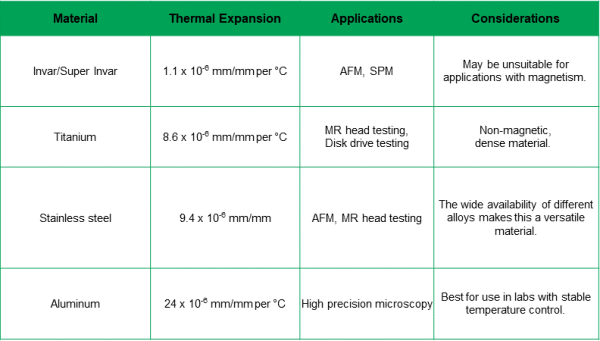
Metals – Temperature Expansion Coefficients (engineeringtoolbox.com)
Get expert advice for system design
The materials used to construct stages are as critical for measurement repeatability as the piezo actuators, but for any nanopositioning system there are a lot of other factors to consider. While thermal characteristics are an important aspect of material selection, budget, environment, dynamic performance, and lifetime reliability are also critical. For that reason Queensgate will always take a holistic view to material selection.
This is where our nanopositioning experts can help. As well as our standard products, we offer a full customization service and our engineers have a wealth of experience in precision positioning applications.
Mehr Blogs
Microscopy and Precision Positioning Glossary: Terms, Definitions and Industry Guide
Erfahren Sie mehr
ProScan H100A – kompakter, motorisierter XY-Mikroskop-Tisch für die Präzisionsmikroskopie: Fragen und Antworten mit dem Produktmanager
Erfahren Sie mehr
Wie ein motorisierter Filterwürfel-Revolver die Mikroskopleistung in fortschrittlichen Imaging-Workflows erweitert
Erfahren Sie mehr