The importance of accuracy and repeatability
23.07.25
In fields where precision motion is crucial, the movements of your control systems and positioning stage define the quality and reliability of your work. From viewing biological samples to sub-micron-level work, your results rely on two fundamental performance metrics: achieving the required accuracy and repeatability.
Often, these two terms are misunderstood. You may even see them used interchangeably. But in precision motion control – particularly at the micro- and nano-scale – the difference is significant. Understanding how they relate to overall system performance is critical when selecting the right equipment for your application.
In this guide, we’ll learn about the differences between accuracy and repeatability, what affects them both, and the roles they play.
What is the difference between accuracy and repeatability?
First, it’s important to define accuracy vs repeatability:
-
Accuracy refers to how closely a system’s positioning matches its target. The result can be judged by how closely a movement aligns with the position it was instructed to move to, often measured in microns or nanometres.
-
Repeatability describes the ability of the system to return to that same commanded position consistently across multiple attempts. It can be quantified by standard deviation or other metrics that indicate consistency.
In this way, a piece of equipment can be highly accurate, highly repeatable, or both. It may also be neither. Understanding the demands of the task in hand dictates which of these characteristics your motion or positioning system will need.
Examples of accuracy vs repeatability
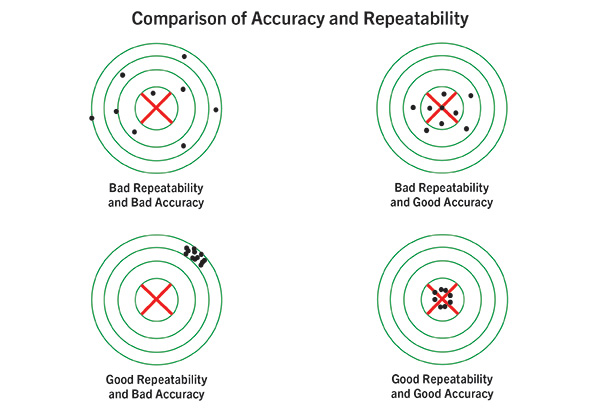
Below are the four quadrants of performance common in motion systems.
1. High accuracy and high repeatability
In this type of system, the stage or platform lands on the commanded point, and does so every time it moves. This is ideal for high-precision, intricate workflows, such as semiconductor wafer metrology, hard disk drive read-write head testing or super-resolution microscopy, where even slight errors in movements have a significant impact.
For example,Queensgate's ultrafast NPS-X-28X stage can achieve sub-nanometer accuracy and repeatability in ideal lab conditions. It is therefore suitable for tasks like evaluating the performance of latest generation hard disk drive magneto-resistive read/write heads which have to read data tracks less than 100 nm in width.
2. High accuracy and low repeatability
Here, the average result may be correct. However, the variation is too wide for the most intricate applications. These systems may be used in environments where only general accuracy is required but performance is not repeatable enough for consistent data capture or automation.
3. Low accuracy and high repeatability
With low stage accuracy but high repeatability, the equipment always moves to the same place. However, it is not the correct place.
4. Low accuracy and low repeatability
Systems in this quadrant behave inconsistently on both measures. As such, they are unsuitable for precision work but might serve in very rough alignment scenarios, or for other workloads where such high precision is simply not necessary.
What factors affect accuracy and repeatability?
The starting point of both the accuracy and precision of positioning systems is two things:
-
How we create motion
-
How we measure it.
Performance at the micron and sub-micron level is achieved by carefully integrating multiple design elements. Each of them influences accuracy, precision and overall system performance.
1. Measurement technology
The underlying technology of a motion control system dictates its possible performance levels. For example, using high-end capacitive sensors is ideal for extremely precise stage positioning. They offer low-noise, high-bandwidth performance that supports accurate measurements across demanding applications.
At Prior, we exclusively use two-plate capacitive sensors in our Queensgate piezo nanopositioning stages to achieve high accuracy and precision.
2. Actuation technology
Piezoelectric actuators, used to drive Queensgate's nanopositioning stages, allow for frictionless and backlash-free motion. Their movement is based on solid-state crystal deformation under voltage, allowing unlimited resolution in theory.
This makes them ideal for sub-micron positioning, especially where nanometer steps across the x-axis or y-axis are required.
3. Controller electronics
Precision motion also depends on the controller’s ability to interpret the sensor data and adjust actuator movement. High-resolution, low-noise electronics help maintain both accuracy and repeatability across a wide travel range.
4. Mechanical design
Finally, mechanical elements must be engineered to minimize inaccuracies and imperfections. For example, high-performance stages are often built using mechanisms that minimize backlash, hysteresis and motion errors like cross-talk or rotations, providing smooth, controlled movement. This is ideal for XY stage systems used in microscopy, for instance.
The benefits of working with high accuracy and repeatability
There are many advantages of working with equipment that is both accurate and repeatable. For example:
-
Confidence in data and results – In applications like wafer inspection, even a one-micron error in the stage position can throw off measurements when imaging at certain magnification levels. High-performance positioning means measurements correlate precisely to real-world structures.
-
Smoother and faster workflows – With repeatability, automated scanning or imaging processes become faster and more efficient, with no need for constant calibration or repositioning.
-
Improved quality control – In some industries, high accuracy means tighter process control, more consistent products and less waste.
It’s important to remember that high precision and accuracy aren’t always necessary. But when they are, you need the right specification for the job.
Contact us for expert advice or explore our nanopositioning products.
More Blogs
Microscopy and Precision Positioning Glossary: Terms, Definitions and Industry Guide
Learn More
H100A Compact Motorized XY Microscope Stage for Precision Microscopy: Product Manager Q&A
Learn More
How a motorized filter cube turret expands microscope performance across advanced imaging workflows
Learn More